

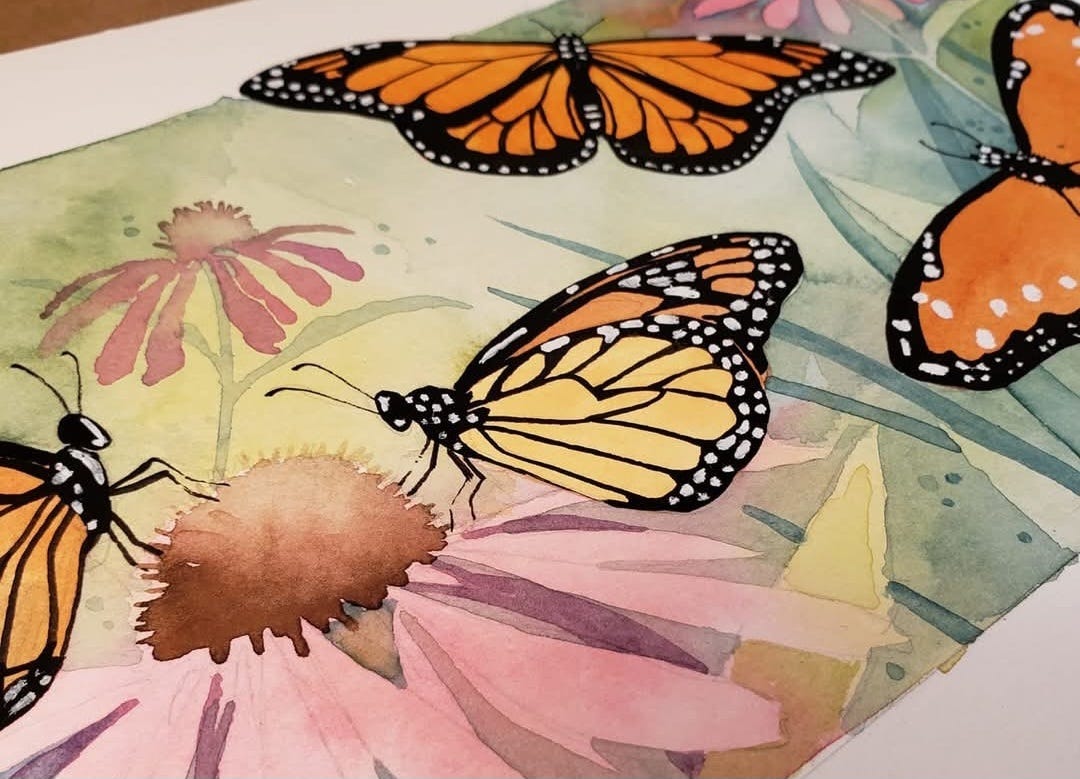
BEAUTIFUL LOOK-ALIKES
In the steaming summer of 1838, deep in the Brazilian rainforest, naturalist Henry Walter Bates made a surprising discovery. Bates was studying tropical butterflies, and he noticed that some harmless species evolved to become virtually identical to toxic ones. Masquerading as a noxious insect protected the harmless species from predators. Forever after, the phenomenon would be known as Batesian mimicry.
At nearly the same time, in a different part of the Brazilian rainforest, German naturalist Johann Muller made a slightly different discovery. Muller was also studying tropical butterflies... but he noticed cases where two equally toxic species evolved to resemble each other, providing more confusion for predators. His discovery was dubbed Mullerian mimicry.
In this lesson, we will paint three species who benefit from Mullerian mimicry: the Monarch, the Viceroy and the Queen butterfly. All are toxic to birds. With a few key differences, they are similar enough to be very difficult to identify on the wing.
(NOTE: We will use wet-on-wet watercolor, so heavy watercolor paper is ideal. Even 140 lb paper may need to be taped down to prevent buckling.)
Click to watch the video:
