
Gentle Garden
Botanicals and pollinators in velvety carbon pencil

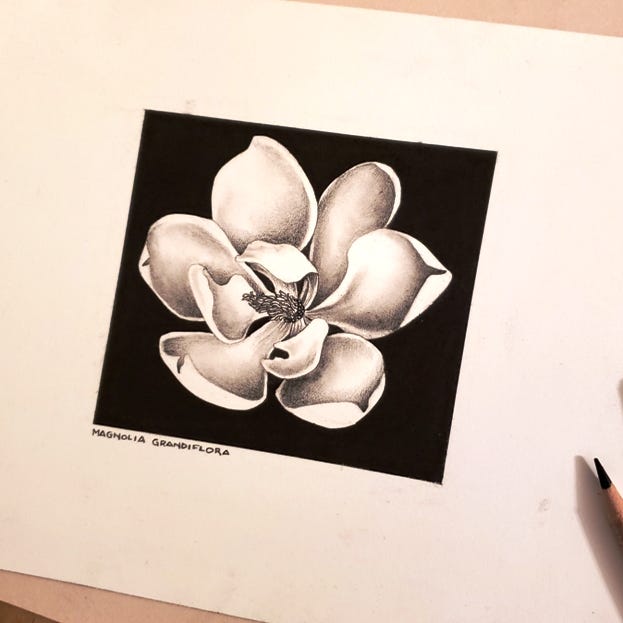
Less smudgy and easier to control than charcoal, richer and darker than graphite - and with no graphite “shine” - carbon pencil is a sensitive and satisfying medium for botanical drawing. In 12 step-by-step video lessons, learn new techniques while drawing a wide range of flowers and their pollinators.
This course is designed to demonstrate the unique characteristics of carbon pencils. If you use graphite or charcoal instead, you will get very different results from what is demonstrated in our class videos. It’s OK to use substitutes for most of the items on our supply list, but carbon pencils are at the heart of the techniques we’ll be using. I strongly encourage you to use the four pencils recommended below.
Most of our supplies are small, ordinary, and pretty much available anywhere that art supplies are sold. Mine were ordered from Dick Blick, but you can find them all over:
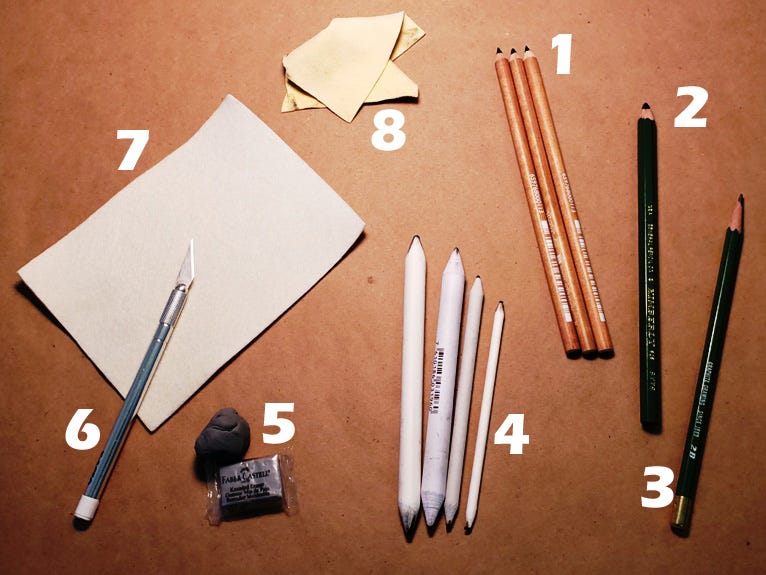
Wolff’s Carbon Pencils B, 2B, 6B
General’s Kimberly 9XXB extra extra soft pencil
Regular drawing pencil, 2B any brand you like
At least one large and one smaller blending stump
A kneaded eraser
A square of ordinary felt (the kind you use for crafts)
X-acto knife
A small chamois
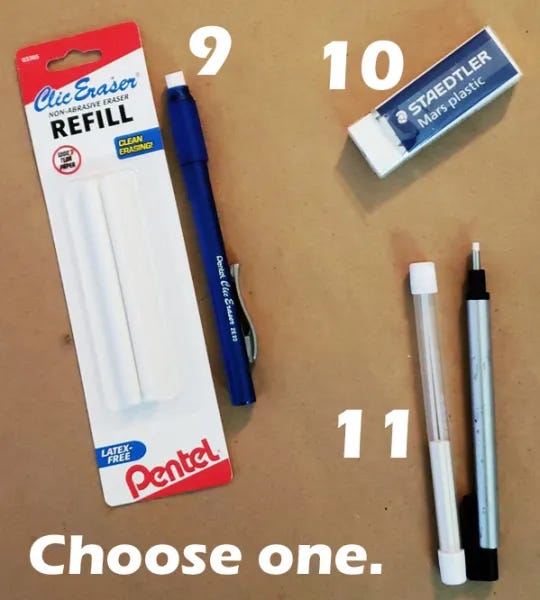
Clic retractable eraser (You will need some type of white plastic eraser. Either 9, 10 or 11 will serve you just fine for our course. I have all three and like them. Choose one or — even better — perhaps you already have one lying around somewhere! The Clic eraser is often sold with school supplies or office supplies.)
Staedtler Mars plastic eraser
Tombow Mono Zero round eraser
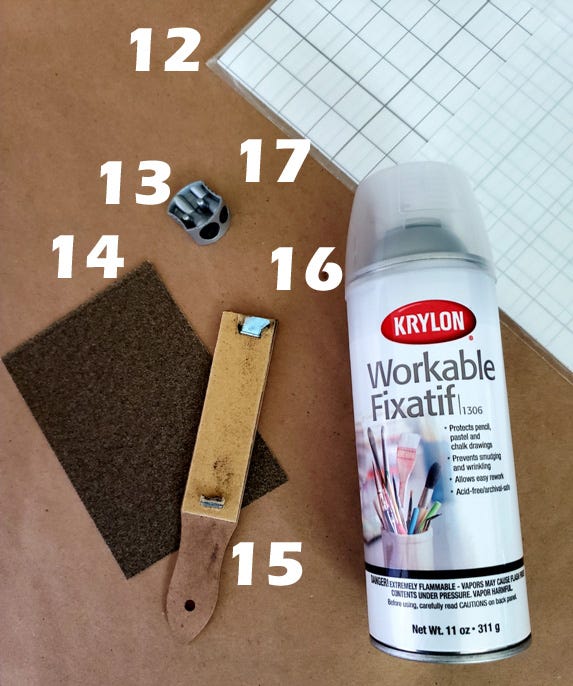
Frisket film (I ordered mine from Dick Blick, but it is often sold in office supply stores. IMPORTANT: You want LOW-TACK frisket film, which will not damage your paper when you remove it. If you are offered a choice of glossy or matte, either is fine. Liquid frisket will not work for us.
A pencil sharpener big enough to accommodate the Kimberly 9XXB pencil, which is similar in girth to those huge pencils you used in kindergarten. My beloved electric sharpener is too small, so I use a two-hole handheld one for just that pencil. If you have an electric with several sizes of holes, you may be able to sharpen it the easy way.
Very fine sandpaper OR…
A sandpaper block. We will need to hone some extra-fine points and sandpaper will also allow us to trap carbon pencil dust to use for some drawing effects.
Workable fixatif (not varnish or regular fixatif) for stabilizing areas with heavy carbon pencil coverage. We will mostly use it for black backgrounds, but you can also use it to protect all the drawings you create during the course. Craft stores and big box stores carry it. Some mail order companies don’t like to ship aerosol cans. We will not be drawing black backgrounds until well into the course, so you don’t need to have this at the beginning.
Surprise! There isn’t a picture to go with this number. This is where we talk about which paper to use for the class. For all my carbon pencil work, I use 140 lb hot press Arches watercolor paper exclusively, because it gives such beautiful results and happily tolerates being repeatedly drawn upon, erased, rubbed with blenders and drawn upon again. There is nothing worse than damaging your paper halfway through a project. (And some papers trap the carbon pencil in their surface fibers and then you can’t erase to create highlights.) Two big sheets will easily carry you through the whole course with some to spare, or you can order a pad of 12 sheets online (recently Jerry’s Art-a-Rama had 9×12 pads for about $15). If you already have another brand of hot press watercolor paper, I would bet that it also work well.
LESSON 1: RED POSTMAN BUTTERFLY
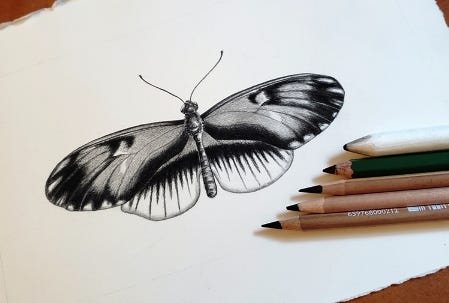
We will begin our exploration of carbon pencils with a tropical butterfly whose markings make him fun to draw: the toxic but lovely red postman, Heliconius erato. Carbon pencil has a special ability to mimic the texture of a butterfly’s wing. Prepare to be impressed!
The first video demonstrates how to make an accurate preliminary sketch. Even if you plan to transfer the printed sketch for your carbon pencil practice, I encourage you to watch both videos all the way through. There is a lot of additional info tucked in alongside the sketching process.
